
AI Is Becoming a New Gatekeeper in the Purchase Journey
AI is becoming part of the purchase journey faster than many brands may realise.
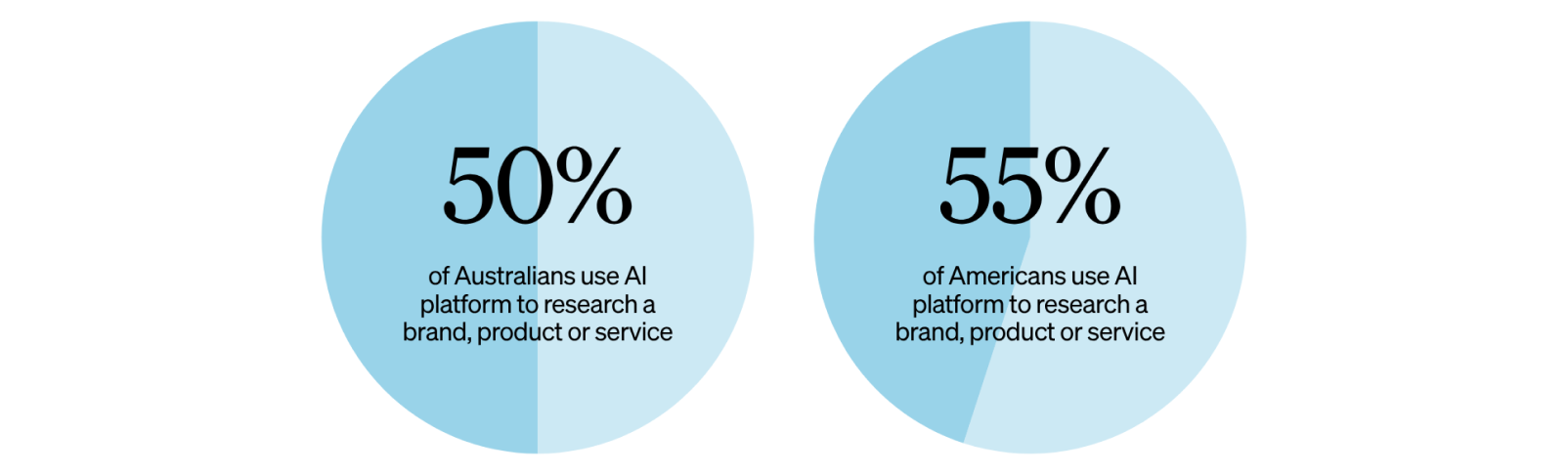
Half of Australians have used an AI platform such as ChatGPT, Claude, Gemini or Google AI Overviews to research a brand, product or service before buying. In the US, that rises slightly to 55%. More than a quarter of consumers in both markets are already doing it regularly, at 27% in Australia and 29% in the US, according to our research of 1,618 consumers across Australia and the US.
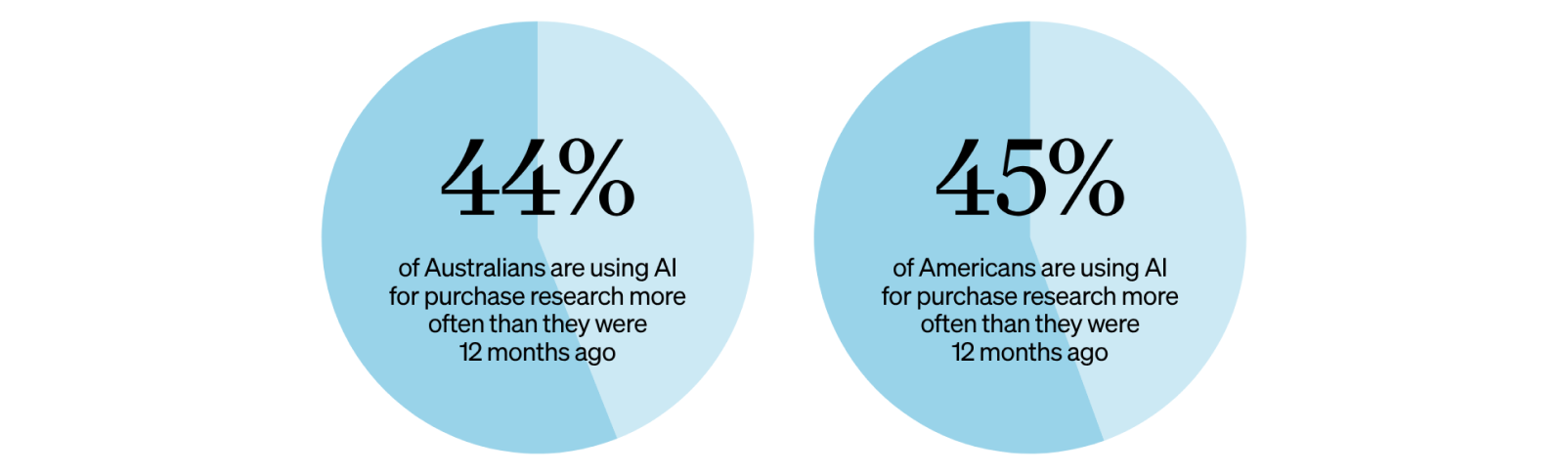
The behaviour is growing quickly too. Some 44% of Australians and 45% of Americans say they are using AI for purchase research more often than they were 12 months ago.
For marketers, that creates a new gateway into the consideration set.
ChatGPT is becoming a discovery channel
Google remains the dominant research platform in both markets, but ChatGPT is already playing a meaningful role.
When consumers were asked what they used the last time they researched a product or service before buying, 31% of Australians selected ChatGPT, compared with 66% for Google. In the US, ChatGPT was used by 29%, compared with Google at 59%.
The shift is particularly pronounced among younger consumers. ChatGPT usage rises to 54% among Australian 25 to 34-year-olds and 48% among Americans under 25.
That means the question for brands is increasingly moving beyond how they rank in search to how they appear when a consumer asks an AI platform what to buy.
AI can get you onto the shortlist. Trust still closes the gap.
When an AI assistant recommends an unfamiliar brand, 52% of Australians say they would search for the brand first and another 21% would check review sites. Just 3% would buy based on the recommendation alone.Americans are slightly more willing to act on the recommendation, but the pattern is similar. Some 44% would search for the brand first, 20% would check reviews and only 7% would buy based on the AI recommendation alone.
AI itself also remains a relatively low-trust source for major purchases. Only 6% of Australians and 9% of Americans selected an AI assistant as the source they would trust most for a recommendation. Google search, friends and family, and online reviews all ranked higher in both markets.
“For brands, that means AI visibility cannot sit in isolation,” says Donald. “You need to understand how you show up across AI platforms, search, reviews, earned media and other credible third-party sources because consumers are moving between all of them before making a decision.”
Why original research matters for GEO
This is where the connection between PR and GEO becomes much more important.AI systems need credible source material to reference, while journalists need something new and useful to report. Original research can do both, creating newsworthy information that earns coverage and then contributes to the wider body of third-party material around a brand.
Put simply: journalists need something new to report, AI needs sources it can reference, and original research gives you both.
With earned media being proven to have an outsized influence on Generative Engine Optimisation (GEO), we are seeing brands turn to Ideally to use data-led storytelling as the crux of their pitches.
In practice, brands are already using research this way. Betty’s Burgers added a rapid consumer study to the launch of its Madman Burger, creating a fresh behavioural angle that extended the campaign into a five-minute Today Show segment. A large financial services brand uses overnight surveys around live news moments to generate timely earned coverage and build a growing library of credible, indexable source material.
Consumers are less ready to hand over the decision
The next frontier is agentic AI, where AI moves from helping consumers research a decision to making it for them.
Only 4% of Australians would allow an AI agent to automatically switch them to a cheaper provider, compared with 11% of Americans. Another 29% of Australians and 26% of Americans would allow AI to do it with their final approval.
Younger consumers are more open to handing AI greater control, suggesting this part of the purchase journey could shift considerably as AI use becomes more established.
What this means for brands
Consumers are already moving between AI, search, reviews, media and other sources before they buy.For brands, that makes GEO a broader reputation and information problem. The brands most likely to surface are the ones surrounded by credible, useful information that AI systems can find, reference and trust.Original research is one way to build that advantage. It gives journalists something worth covering, audiences something worth sharing and AI something credible to reference.
The brands that win will be visible when consumers ask AI the question, and credible when they go looking for proof.

